Streamline Your Workflow with Business and Office Related Icons
Every professional knows the frustration of trying to communicate a complex idea quickly. Whether you are preparing a pitch deck, updating a project dashboard, or designing an internal memo, the right visual shorthand can make the difference between clarity and confusion. That is where a well-curated set of Business and Office Related Icons becomes an indispensable resource. These simple, outline-based vector illustrations offer a universal language for tasks, people, documents, and deadlines, helping you move from a cluttered concept to a clean visual story in seconds.
Why Visual Communication Matters in the Office
Modern workplaces are saturated with information. Emails, reports, meeting notes, and project plans compete for attention. When every element on a page fights for the reader's focus, important messages get lost. This is the core challenge that a comprehensive icon set addresses. By using consistent, recognizable symbols, you reduce cognitive load. Your audience does not have to read every word to grasp the structure of a presentation or the status of a task. Instead, they see a calendar icon and instantly know you are talking about scheduling. They see a person icon and understand it is about collaboration or roles.
Many teams struggle with keeping communication consistent across departments. Marketing uses one style of graphic, engineering uses another, and leadership uses a third. The result is a fragmented brand experience. A unified library of Business and Office Related Icons provides a common visual vocabulary. Everyone, from the intern to the CEO, can use the same icons to represent the same concepts, creating a cohesive look that builds trust and reduces misinterpretation.
What a Versatile Icon Collection Offers
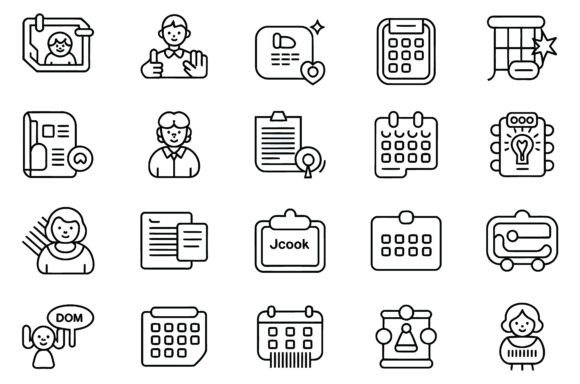
A comprehensive vector illustration set goes beyond just a few basic shapes. It typically includes a wide range of symbols that cover the full spectrum of business activities. In a well-designed collection, you will find:
- People and profiles: Representations of individuals, teams, and user personas for HR documents, org charts, or login screens.
- Documents and files: Symbols for contracts, reports, invoices, and checklists, making it easy to differentiate between types of content.
- Calendar and scheduling: Icons for events, appointments, reminders, and deadlines that help users manage time visually.
- Communication tools: Email symbols, chat bubbles, and phone icons that clarify how information flows.
- Ideas and innovation: Lightbulbs, gears, and thought bubbles to represent brainstorming, strategy, and problem-solving.
- Business processes: Arrows, charts, and task lists that illustrate workflow, progress, and project management stages.
When you have access to a collection like this, you no longer need to hunt for the perfect graphic or settle for a poorly matched alternative. You can pull exactly what you need, knowing it will fit the clean, modern aesthetic of your project.
Addressing Common Workplace Challenges
Professionals face several recurring pain points that a good icon set can solve. One of the most common is time wasted on design. A manager preparing a quarterly review might spend hours trying to make data visually appealing. With a ready-to-use set of Business and Office Related Icons, they can quickly add simple outline graphics that turn raw data into a story. This saves hours of formatting and leaves more time for analysis.
Another issue is accessibility. Not everyone processes written information at the same speed. Visual cues help non-native speakers, individuals with learning differences, and even overwhelmed executives who are skimming. Icons act as signposts, guiding the reader through the content without requiring them to parse every sentence. This makes your documents and presentations more inclusive and effective.
Consistency is another major hurdle. When different team members create their own slides or documents, the visuals often clash. One person uses colorful photographs, another uses detailed illustrations, and a third uses generic clip art. The result is a disjointed brand image. By adopting a single source of Business and Office Related Icons, you enforce a standard visual language. Your materials look like they belong together, even when created by different people.
Practical Applications Across Roles
Different users will find different value in a vector icon collection. Let us explore how various professionals can put these icons to work.
Project Managers and Team Leads
If you oversee complex projects with multiple stakeholders, you know the importance of clear status updates. Using icons for tasks, milestones, and team members on your Gantt chart or Kanban board makes it easy for everyone to see progress at a glance. A checklist icon next to a completed item feels rewarding. A calendar icon beside a deadline creates urgency. These small visual cues keep the team aligned without requiring lengthy explanations.
Marketers and Content Creators
For those who create blog posts, landing pages, or social media assets, icons are a quick way to break up text and highlight key points. A set of Business and Office Related Icons can be used to illustrate each step of a process, represent different service offerings, or add visual interest to bullet points. Because the icons are simple outlines, they work well in both light and dark modes, and they scale cleanly from mobile screens to presentation projectors.
Human Resources and Training Professionals
HR teams often deal with dense policy documents and training materials. Adding icons next to each section header helps employees find information faster. A person icon for employee profiles, a document icon for policies, and a calendar icon for training dates make the content more scannable. This improves compliance because people can quickly locate the specific guidelines they need.
Freelancers and Small Business Owners
When you run your own business, you wear many hats. You might not have a dedicated designer, but you still need professional-looking materials. A vector icon collection gives you access to high-quality visuals without the cost of custom illustration. You can use them in proposals, invoices, client presentations, and your website. This helps you present a polished image that competes with larger companies.
Choosing the Right Set for Your Needs
Not all icon collections are created equal. When evaluating a set of Business and Office Related Icons, consider a few key factors. First, look at the style consistency. All icons should share the same line weight, corner radius, and overall design philosophy. Mixed styles create visual noise. Second, ensure the set includes the specific symbols you use most. If you frequently deal with email communication, make sure there is a clear envelope or message icon. If you run meetings constantly, confirm there is a reliable calendar or clock symbol.
Scalability matters too. Since these are vector illustrations, they should remain sharp at any size. Test how the icons look at 16 pixels for a tooltip and at 64 pixels for a hero section. The best collections maintain clarity across all dimensions. Also, think about format. Icon sets that come in SVG, PNG, and EPS give you the flexibility to use them in web design, print, and slide decks without conversion headaches.
Implementation Tips for Maximum Impact
To truly benefit from your icon collection, integrate it into your regular workflow. Create a shared library or resource folder that your entire team can access. Standardize which icons represent which concepts. For example, always use the same calendar icon for deadlines and the same person icon for stakeholders. This builds visual consistency over time.
When designing documents, pair icons with short labels for maximum clarity. An icon alone might be ambiguous, but an icon next to a one-word label is immediately understood. Use icons to create visual hierarchies. Place a larger version of an icon next to a main heading and smaller versions next to subpoints. This guides the reader through the structure of your content naturally.
Consider color sparingly. Since the icons are black and white outlines, you can use a single accent color to highlight the most important elements. This keeps the design clean while drawing attention to key actions or data points. For instance, keep most icons in a neutral gray and use a brand color only for call-to-action symbols or urgent alerts.
Real Outcomes You Can Expect
When you adopt a thoughtful approach to using Business and Office Related Icons, the results go beyond aesthetics. You will likely see faster comprehension in your team. Meetings become shorter because visuals convey information that words take longer to explain. Documents become more engaging, which means people actually read them. Your brand identity becomes stronger because every piece of communication shares a cohesive visual thread.
For clients and external stakeholders, professional-looking materials build credibility. When you present a proposal that uses clean, consistent icons, you signal that you have attention to detail and respect for the audience's time. This can translate into stronger relationships and more closed deals.
On a personal level, you reduce your own frustration. No more searching for the right image or trying to explain a concept without visual support. You have a reliable toolkit that works for any business scenario. Whether you are building a website, preparing an infographic, or organizing a project plan, the icons are ready to support your message.
Tailoring to Different Work Styles
Some professionals prefer a minimalist approach. They use icons sparingly, adding them only to headers and key callouts. Others like a more visual style, embedding icons in every section and using them as decorative elements. Both approaches work, as long as the icons serve a purpose. Let your content dictate the quantity. If you are explaining a step-by-step process, use an icon for each step. If you are writing a dense policy, use icons as wayfinding markers rather than decoration.
Teams that work remotely can benefit especially from shared icon libraries. When everyone is distributed, visual consistency becomes a unifying force. A shared set of Business and Office Related Icons ensures that a slide deck from the New York office looks like it came from the same team as one from the Tokyo office. This unity fosters collaboration and reduces the friction of cross-cultural communication.
Future-Proofing Your Visual Toolkit
As your business evolves, your icon needs will change. A good collection offers enough breadth to grow with you. Start with the icons you need today, but keep the full set accessible for future projects. When you pivot to a new service, launch a new product, or restructure your team, you will already have the visual language to communicate the change clearly.
Investing in a quality set of Business and Office Related Icons is not just about solving today's problems. It is about building a system that makes every future communication easier, faster, and more effective. By replacing confusion with clarity and clutter with clean design, you empower your team to focus on what really matters: doing great work and moving your business forward.