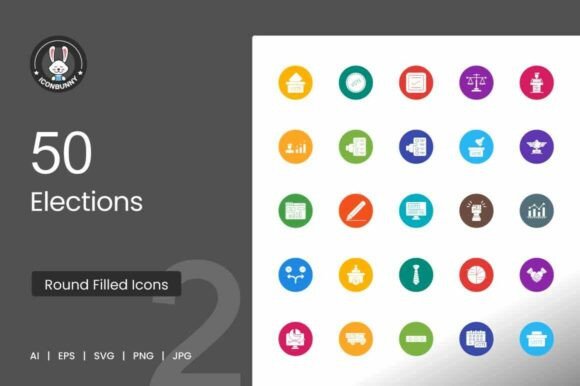
Elections Round Filled Icons: Visualizing Democracy in Modern Design
The Role of Iconography in Electoral Communication
In an era where information is consumed rapidly and attention spans are measured in seconds, visual language has become a cornerstone of effective communication. Elections Round Filled Icons fill a critical niche in this landscape by converting abstract democratic processes into instantly recognizable symbols. Whether displayed on a voter registration portal, embedded in a campaign infographic, or printed on a civic education pamphlet, these icons reduce cognitive load and help audiences grasp meaning without reading a single word. The round filled format is particularly effective because it creates visual consistency, allowing icons to sit comfortably alongside text, buttons, or other UI elements without appearing disjointed.
When designers and content creators work on election-related projects, they often struggle to find imagery that balances neutrality with emotional resonance. Generic stock photography can feel staged or culturally specific, while overly abstract illustrations risk confusing the viewer. The 50 icons in this collection strike a deliberate balance: they depict concrete election activities—voting booths, ballot boxes, ID verification, campaign rallies, political debates, candidates, flags, law symbols, and democracy motifs—while using a consistent round filled silhouette that feels contemporary and trustworthy. This makes them especially suitable for projects that require both professionalism and approachability.
File Formats and Resolution
The set is distributed in AI, EPS, SVG, PNG, and JPG formats, each at 1024×1024 pixels with 72 DPI. This resolution is ideal for digital screens, web use, and standard print materials. SVG files offer scalability without loss of quality, making them perfect for responsive websites and mobile applications. The AI and EPS vectors allow advanced customization in professional design software, while PNG and JPG provide drop-in convenience for quick layouts. Designers working in Canva, Illustrator, Figma, and Sketch will find the formats natively compatible, reducing friction during import.
Eight Distinctive Styles
One of the standout characteristics of this icon pack is its availability in eight distinctive styles. This variety means that a single set can serve multiple projects without visual repetition. A government agency might use a clean monochrome round filled style for official documentation, while a youth-oriented civic education app could opt for a vibrant, saturated version of the same icons. Campaign teams might prefer a high-contrast style for outdoor signage, and news platforms can use a subdued palette for editorial infographics. The round filled base remains constant, ensuring brand coherence even as the aesthetic shifts.
Editable and Resizable Vectors
All icons are fully editable and resizable. This is a practical advantage for organizations that need to adapt visuals to specific brand guidelines. Colors can be adjusted to match a campaign's palette, strokes can be thickened or thinned, and individual elements within an icon can be rearranged. For example, a ballot box icon could be recolored from neutral gray to the red, white, and blue of a national election, or a candidate podium icon could be scaled to serve as a hero image on a landing page. The vector nature ensures that scaling never introduces pixelation, which is critical for both large-format printing and retina displays.
Government Agencies and Election Commissions
Official election bodies are responsible for communicating complex procedures to diverse populations. Elections Round Filled Icons can be deployed on voter registration portals to illustrate required documents, step-by-step voting guides, and polling station locators. For instance, an ID verification icon paired with a brief text explanation helps voters understand what identification they need to bring. A ballot box icon next to a deadline date clarifies where and when to submit votes. These visual cues reduce errors and improve user confidence, especially among first-time voters or those with limited literacy in the official language.
Political Campaigns and Candidate Teams
Campaigns operate under tight timelines and need visual assets that are immediately recognizable and emotionally engaging. Rally icons, podium visuals, flag symbols, and debate illustrations can populate social media graphics, email newsletters, and yard sign mockups. The round filled style works well in profile picture badges, app icons, and push notification illustrations. A campaign might use a raised-hand icon to signify "support" or a loudspeaker icon for "announcement," creating a consistent visual shorthand across all communications. Because the icons are available in multiple styles, campaign designers can mix and match according to platform requirements—using a detailed style for print and a simplified one for mobile.
Civic Education and Nonprofit Organizations
Organizations focused on voter turnout, democratic participation, and civic literacy often produce educational materials for schools, community centers, and online courses. Icons depicting law symbols, democracy motifs, and voting booths make learning materials more engaging. A lesson plan about the legislative process might use a law book icon alongside a ballot box icon to show the connection between lawmaking and voting. A voter awareness drive could print flyers featuring a round filled checkmark icon to signify "registered to vote." The clarity of the round filled format is especially important when materials are printed in black and white or viewed on low-resolution screens in underserved areas.
News Channels and Digital Media Platforms
Journalists and news producers covering elections need visuals that convey neutrality and authority. Elections Round Filled Icons can be used in live election trackers, candidate comparison charts, and explainer articles. A news website might place a debate icon next to a headline about an upcoming presidential debate, or use a flag icon to denote national election results. The consistent round shape creates a clean grid layout when multiple icons are used side by side, which is common in data dashboards and scorecards. Because the icons are not tied to any specific political party or candidate, they maintain editorial impartiality.
Social Impact and Grassroots Movements
Community organizers and advocacy groups often operate with limited budgets and need design assets that are both professional and affordable. This icon set provides a ready-made visual language for posters, social media templates, and zines. A grassroots group encouraging voter registration could use the checkmark and ballot box icons to create a simple call-to-action graphic. A get-out-the-vote campaign might pair a clock icon with a voting booth icon to remind people of polling hours. The round filled style feels inclusive and modern, resonating with younger audiences while remaining respectful to older voters.
Round Filled Silhouette as a Design System
The choice of a round filled format is not merely aesthetic—it has practical implications for user interface design. Round icons tend to feel softer and more approachable than sharp-edged squares, which is beneficial in contexts where trust and civic duty are central themes. When used within a UI component such as a button or a notification badge, the circular shape naturally draws the eye without competing with other elements. The filled nature ensures that the icon remains legible even at small sizes, because there is no empty space to cause ambiguity. For accessibility, the solid fill provides high contrast against light or dark backgrounds, aiding users with low vision.
Customization Workflows for Different Platforms
Designers working in Canva, Illustrator, Figma, and Sketch will appreciate the streamlined workflow. In Canva, the PNG and SVG files can be uploaded directly and resized within the interface. In Figma, the vector icons become components that can be referenced across multiple frames, ensuring consistency. Illustrator users can open the AI or EPS files and access every anchor point, allowing precise alignment with brand grids. The icons include metadata and logical file naming, which saves time when searching for specific symbols within a large library. A campaign manager might export a subset of icons as PNG for email signatures, while a web developer pulls the SVGs for inline use on a voter information site.
Cultural and Contextual Sensitivity
While icons are designed to be universal, elections are deeply contextual. A ballot box icon that looks like a specific model used in one country might differ from the design used in another. The strength of Elections Round Filled Icons lies in their abstraction—they depict the essence of an object or action rather than a specific real-world counterpart. This makes them adaptable across different electoral systems. However, practitioners should review the icons for local relevance before widespread deployment. For instance, some voting systems use paper ballots, while others use electronic machines; an icon set that includes both allows the designer to choose the most appropriate representation.
Licensing and Scalability for Large Teams
Organizations working across departments or with external partners should confirm the licensing terms of the icon pack. The availability of AI and EPS files is particularly valuable for large enterprises that need to distribute branded templates to regional offices. Because the icons are resolution-independent, they can be scaled from a mobile app icon of 48×48 pixels up to a billboard graphic of several feet without quality loss. This scalability reduces the need to maintain multiple versions of the same symbol, simplifying asset management.
Filled vs. Outline Icons
Outline icons have their own merits—they are lightweight and work well in minimal designs—but they often struggle with legibility at small sizes. The round filled format addresses this by providing a solid mass of color that remains visible even when compressed. In election materials where text density is high and space is limited, such as ballot instructions or voter guide infographics, filled icons stand out without requiring additional background shapes. They also convey a sense of solidity and reliability, which aligns with the seriousness of democratic participation.
Round vs. Square Container
Icons inside round containers have become a standard in modern app design, particularly on iOS and Android. By adopting this shape, the icon set integrates naturally into mobile interfaces, notification centers, and profile badges. Square containers can feel more corporate or rigid, which may not suit the inclusive and community-oriented tone that many election projects aim for. The round shape softens the visual impact and encourages interaction, making it a preferred choice for call-to-action buttons and interactive widgets.
Enhancing Voter Engagement Through Visual Consistency
Voter engagement campaigns are most effective when messaging is clear and consistent across all touchpoints. When an icon set is used uniformly on a website, social media, print materials, and signage, it creates a recognizable visual identity that reinforces trust. A voter who sees a specific ballot box icon on a registration portal will quickly associate it with the same icon on a polling station sign. This visual continuity reduces confusion and builds a sense of familiarity with the electoral process.
For example, a comprehensive voter awareness drive might deploy the icons in the following ways: the ID verification icon appears on instructional posters, the ballot box icon is used on directional signage at polling places, the debate icon accompanies candidate comparison articles on a news site, and the flag icon is featured in social media graphics celebrating election day. The round filled style ties all these materials together, so even if the color scheme changes across platforms, the silhouette remains instantly recognizable.
Future Trends in Elections Iconography
As digital platforms continue to evolve, the demand for versatile, scalable, and inclusive visual assets will only grow. Elections Round Filled Icons are positioned to meet these needs because they are format-agnostic and style-flexible. Emerging trends such as dark mode interfaces, kinetic typography, and augmented reality voting guides will require icons that function well in varying contrast conditions and scaling contexts. The round filled silhouette performs reliably in dark mode because the solid fill prevents the icon from disappearing into a dark background, and the simple shapes render cleanly in AR environments.
Additionally, as civic education becomes more digitized—with interactive games, simulation tools, and e-learning modules—icons will play a role in navigation and feedback systems. A student completing a mock election activity might see a checkmark icon to indicate a correct answer or a ballot box icon to submit their vote. The emotional reassurance provided by clear, friendly icons can make learning about democracy feel less intimidating and more engaging.
Practical Guidance for Selecting Icons for a Project
When choosing which icons from the set to use, practitioners should consider the primary user action they want to facilitate. For voter registration, prioritize icons related to ID verification, forms, and checkmarks. For election day reminders, focus on ballot boxes, clocks, and location markers. For candidate education, use podium and debate icons. The 50-icons breadth ensures that most common electoral scenarios are covered, but it also means that designers should curate intentionally to avoid visual noise. Using too many distinct icons in a single layout can overwhelm the viewer; a focused selection of three to five icons often has the greatest impact.
Color coding can further enhance meaning. A voter guide might use blue icons for registration steps, green for voting logistics, and gold for important deadlines—all using the same round filled base. This creates a cohesive visual hierarchy that guides the reader through the information without requiring additional design elements. The editable vector files make this kind of systematic color assignment straightforward, as the designer can group icons by purpose and apply global swatches.
Collaboration Across Teams and Disciplines
Election projects often involve collaboration between graphic designers, UX researchers, content strategists, policy experts, and community liaisons. A shared icon set serves as a common visual vocabulary that bridges these disciplines. A content strategist can request a specific icon for a call-to-action, and the designer can deliver it from the set without needing to create custom art. The UX researcher can test icon comprehension with user groups and provide feedback that applies to the entire set. The policy expert can verify that the law and democracy symbols are accurate and appropriate. By reducing the time spent on custom illustration, the team can focus on higher-level strategy and messaging.
Furthermore, the availability of eight styles means that each department can adopt a variation that suits their specific use case while maintaining brand consistency. The communications team might use a bold style for press releases, while the web team uses a simplified style for performance-optimized pages. This flexibility prevents the friction that often arises when different teams interpret brand guidelines differently.
Observations on the Impact of Well-Designed Icons
Over time, consistent use of icons in electoral contexts can contribute to a more visually literate public. When citizens repeatedly see a standard set of symbols associated with voting, they begin to internalize those meanings and respond to them more quickly. This is especially important in multilingual societies where text-based instructions may not reach all residents. A ballot box icon is understood regardless of language, age, or educational background. The Elections Round Filled Icons collection, with its deliberate focus on clarity and adaptability, is well suited to serve as a foundation for such long-term visual literacy initiatives.
Designers and organizations that invest in quality iconography are not just decorating their materials—they are building infrastructure for democratic participation. Every time a voter recognizes a ballot box icon and confidently proceeds to the correct location, or identifies a candidate icon and learns about their platform, the icon has done its job. The round filled style, with its approachable silhouette and robust functionality, ensures that this infrastructure is both effective and enduring.